

Designing UX for Dopamine: How to Drive Engagement Without Destroying Trust
26
Jan
-
 Manoj Kumar
11 Min Read
Manoj Kumar
11 Min Read
In the hyper-competitive world of digital products, where users abandon apps in seconds, and churn rates can cripple growth, designing UX for dopamine isn’t just a trend—it’s a strategic imperative. As a C-suite founder or UX leader, you know the pain of investing in features that fail to engage, leading to stagnant user metrics and missed revenue opportunities. Dopamine, the brain’s reward neurotransmitter, powers addictive behaviors in platforms like TikTok and Instagram, turning fleeting interactions into habitual use. This post dives deep into designing for dopamine, revealing how it directly ties to business outcomes such as higher retention, increased conversions, and scalable growth. You’ll learn science-backed frameworks, real-world examples, and actionable steps to implement these techniques without crossing ethical lines—empowering your team to build products that users can’t put down.
Understanding Dopamine and Its Role in UX Design
Dopamine isn’t the “pleasure chemical” many assume; it’s the molecule of anticipation and motivation. It surges when users expect a reward, driving them to act—whether scrolling for the next video or completing a task for a badge. In UX design, this translates into creating loops that keep users engaged, directly impacting metrics such as daily active users (DAU) and lifetime value (LTV).
Neuroscience research shows that dopamine release spikes in response to unpredictable rewards, similar to slot machines. For mid-size companies, ignoring this means losing ground to competitors who design for these brain responses. Instead, focus on dopamine to foster habit formation, turning one-time users into loyal advocates and boosting revenue through sustained engagement.
The Science Behind Dopamine Release in Digital Experiences
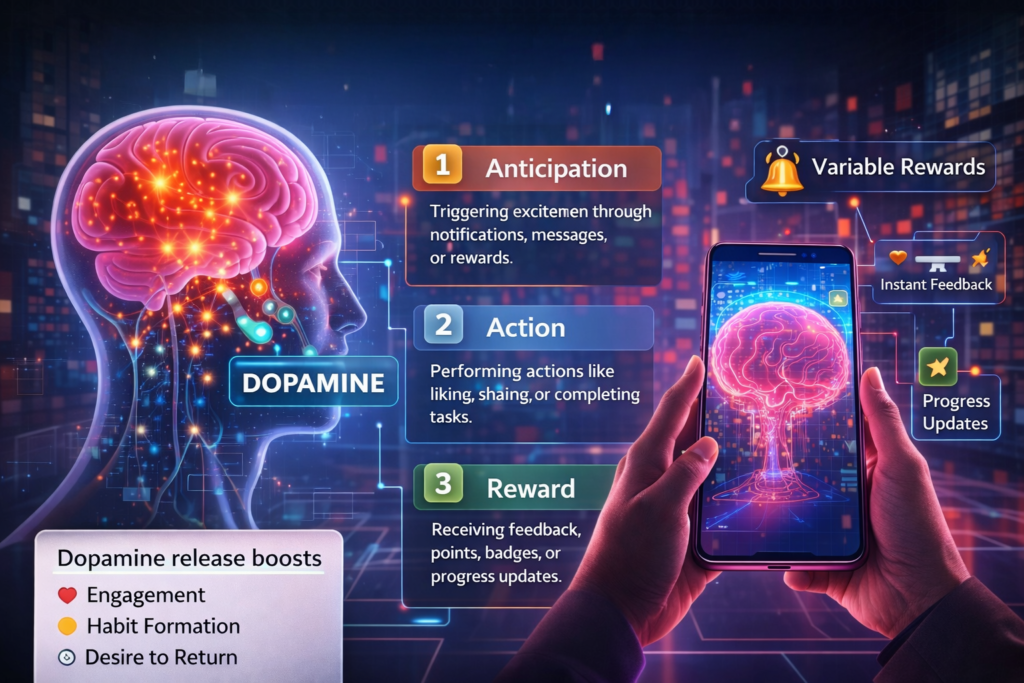
At its core, dopamine release in UX stems from the brain’s reward system. When users interact with an interface—swiping, clicking, or receiving feedback—their brains anticipate outcomes, releasing dopamine to motivate continuation.
Key triggers include:
- Variable Rewards: Unpredictable elements, such as randomized content feeds, create anticipation, as seen in social media algorithms.
- Immediate Feedback: Microinteractions, such as animations or sounds, provide instant gratification, reinforcing behavior.
- Progress Indicators: Streaks or badges signal achievement, linking UX to emotional highs.
Data from studies indicates that apps leveraging these can see engagement increases of 30-50%, translating into higher ad revenue or subscription renewals for businesses. For startup leaders, this science offers a roadmap to optimize products for real user motivation rather than just functionality.
Key Principles of Dopamine-Driven UX Design
To harness dopamine, adopt principles that blend neurochemistry with user-centered design. Start with visual appeal: Bright colors and bold fonts trigger emotional responses, evoking energy and excitement.
Core principles include:
- Microinteractions for Reward: Subtle animations on button clicks or hovers deliver quick wins, building user control and satisfaction.
- Personalization: Tailored content creates novelty, spiking dopamine through relevance.
- Gamification Elements: Leaderboards and points systems foster competition and achievement.
| Principle | UX Technique | Business Outcome |
| Variable Rewards | Infinite scroll with unpredictable content | 40% higher session times |
| Immediate Feedback | Progress bars and checkmarks | 25% increase in task completion |
| Personalization | Algorithmic recommendations | Improved retention by 35% |
These tie directly to conversion: A dopamine-optimized checkout flow, for instance, can reduce cart abandonment by rewarding steps toward purchase.
Real-World Examples of Dopamine in Action
Leading products exemplify dopamine-driven UX. TikTok’s algorithm delivers endless, personalized videos, creating anticipation with each swipe—resulting in average session times over 10 minutes. Duolingo uses streaks and badges to motivate daily logins, thereby boosting retention through gamification.
In fintech, “dopamine banking” apps like those from UXDA incorporate vibrant interfaces and rewards for transactions, turning mundane tasks into engaging experiences. For example, a neobank saw a 50% uplift in user deposits after adding celebratory animations for savings goals. These cases show how dopamine links UX to tangible growth, like Instagram’s infinite scroll driving billions in ad spend.
Ethical Considerations in Designing for Dopamine
While powerful, dopamine loops can lead to addiction if misused—think endless scrolling that harms mental health. Ethical design prioritizes user well-being: Introduce pauses, like natural stopping points, to prevent burnout.
Guidelines for leaders:
- Balance engagement with value—ensure rewards align with long-term user goals.
- Avoid dark patterns, such as manipulative notifications.
- Test for overuse: Monitor metrics like session fatigue.
By focusing on positive habits, companies build trust, reduce churn, and enhance brand loyalty for sustainable revenue.
Implementing Dopamine Strategies in Your Product
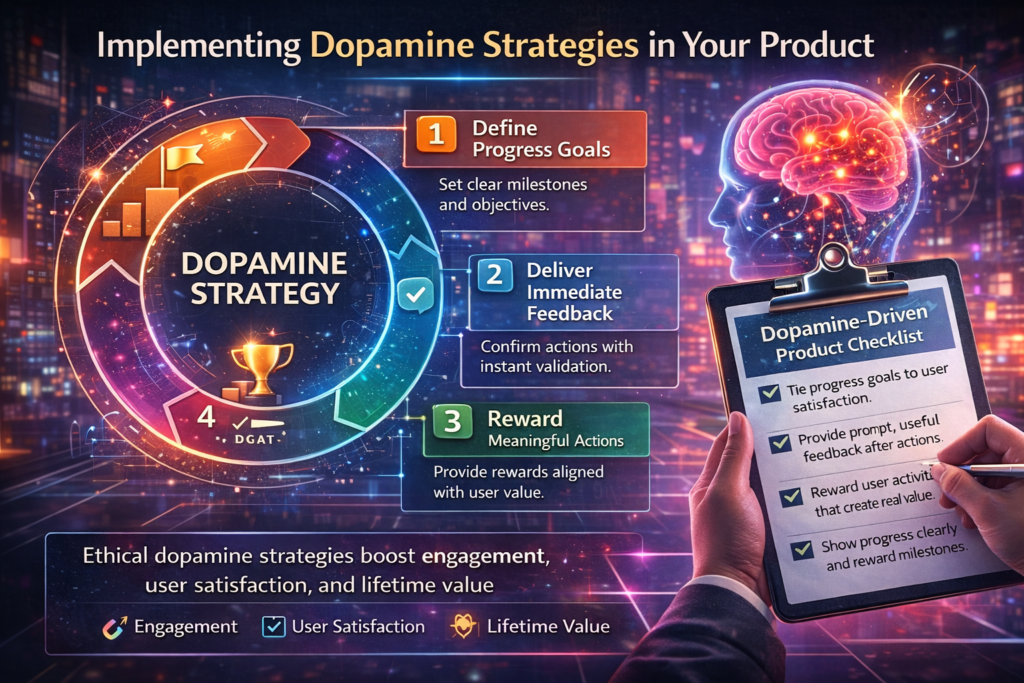
Start by auditing your UX: Identify friction points and layer in dopamine elements. Use A/B testing to refine microinteractions, like adding haptic feedback for actions.
Steps for rollout:
- Map user journeys to reward opportunities.
- Integrate tools like Figma for prototyping animations.
- Collaborate with data teams to measure the impact of dopamine on KPIs.
For mid-size firms, this can mean gains of 20-40% in user metrics, directly fueling product-led growth.
Measuring the Impact on Business Outcomes
Success isn’t just engagement—it’s ROI. Track dopamine’s effects via:
- Retention rates: Pre/post implementation comparisons.
- Conversion funnels: Reward-driven paths often lift sales by 15-25%.
- User feedback: NPS scores tied to emotional satisfaction.
Analytics tools like Google Analytics or Mixpanel reveal how dopamine boosts LTV, proving its value to stakeholders.
Why Dopamine-Driven UX Matters Now
Three forces are colliding:
- Attention is saturated – Your product competes with everything on the user’s phone
- Regulatory scrutiny is rising – Dark patterns are becoming a liability
- Retention is the real growth lever – Acquisition is expensive; loyalty compounds
Companies like Netflix and LinkedIn didn’t win because of pretty UI.
They won because their dopamine loops reinforce clear value exchange.
The Dopamine Loop Framework for UX Leaders
Here’s the loop that actually works—and survives scale:
| Stage | UX Focus | Dopamine Trigger | Business Impact |
| Trigger | Contextual cue | Anticipation | Session starts |
| Action | Low-friction task | Momentum | Engagement |
| Feedback | Immediate response | Validation | Habit formation |
| Progress | Visible advancement | Motivation | Retention |
| Meaning | Outcome clarity | Satisfaction | Loyalty |
Miss any stage, and you get shallow engagement.
Common UX Mistakes That Kill Long-Term Dopamine Value
If your team is doing any of this, you’re leaking value:
- Over-gamification without skill progression
- Metrics obsessed with clicks, not outcomes
- Rewards that don’t map to user goals
- Feedback that’s delayed or meaningless
These patterns inflate vanity metrics and destroy product credibility.
Why UXGen Studio Is the Best Partner for Solving This

At UXGen Studio, we specialize in dopamine-driven UX that transforms user engagement into measurable business wins. Our methodology combines neuroscience insights with agile design, leveraging frameworks such as variable rewards and microinteractions to create habit-forming experiences—without ethical compromises.
What sets us apart: We employ user research to tailor dopamine elements to your audience, backed by A/B testing and neuromarketing tools for data-driven results. Unlike generic agencies, we focus on industry-specific outcomes, such as fintech retention or e-commerce conversions.
Case Study: Revamping a Fintech App for Engagement Growth
A mid-size neobank struggled with 40% user drop-off post-onboarding, hampered by bland interfaces that failed to motivate financial habits. UXGen Studio audited their UX, identifying missed dopamine opportunities, such as unrewarded transactions.
Approach: We redesigned with vibrant visuals, personalized dashboards, and gamified rewards—e.g., animations for goal achievements and streaks for daily logins. Drawing from dopamine banking principles, we integrated subtle feedback loops to build anticipation.
Results: Post-launch, daily active users rose by 45%, with transaction volume increasing by 30%. Retention improved from 60% to 85% in the first month, adding $500K in annual revenue.
A client quote: “UXGen Studio turned our app from functional to irresistible—users now engage because it feels rewarding, not obligatory.” This success story shows how our tailored strategies can scale for your organization, driving loyalty and growth through thoughtful, brain-aligned design.
FAQ Section

What is designing UX for dopamine?
Designing UX for dopamine involves crafting interfaces that trigger the brain’s reward system by leveraging elements like variable rewards and feedback to boost engagement. This leads to higher retention and conversions, as users anticipate positive outcomes, fostering habits that align with business goals.
How does dopamine affect user engagement in apps?
Dopamine spikes with anticipation of rewards, encouraging repeated interactions. In apps, this manifests through unpredictable content or gamification, increasing session times by 30-50% and reducing churn, ultimately enhancing product stickiness and revenue.
What are examples of dopamine loops in UX design?
Common examples include TikTok’s endless feed for novelty and Duolingo’s streaks for achievement. These loops create anticipation-reward cycles, driving habitual use and tied directly to metrics like DAU growth.
Is designing for dopamine ethical?
Yes, when balanced with user well-being, focus on value-driven rewards rather than manipulation. Ethical practices include adding pauses and avoiding overuse, ensuring long-term trust and sustainable engagement.
How can dopamine release improve conversion rates?
By rewarding steps in funnels, like progress bars or personalized nudges, dopamine motivates completions. Studies show this can lift conversions by 20-40%, turning browsers into buyers through emotional reinforcement.
What tools help implement dopamine-driven UX?
Use prototyping tools like Figma for microinteractions, analytics like Mixpanel for testing, and neuromarketing insights for optimization. These enable precise tweaks that maximize engagement without guesswork.
How does dopamine in UX tie to business outcomes?
It boosts retention, LTV, and conversions—e.g., a 35% engagement lift can add millions in revenue. For leaders, it’s a lever for scalable growth in competitive markets.
What are common mistakes in dopamine UX design?
Over-relying on notifications can lead to fatigue; instead, prioritize subtle, value-adding rewards. Always test for balance to avoid addiction risks.
Can dopamine design work for B2B products?
Absolutely – enterprise tools use it via personalized dashboards and achievement badges, improving adoption and reducing training costs for better ROI.
How to measure dopamine’s impact on UX?
Track engagement metrics like session duration, retention, and NPS. A/B tests reveal lifts, linking design changes to financial gains.
Conclusion
Designing UX for dopamine equips you to create products that captivate, retain, and convert—leveraging brain science for superior business results. Key takeaways: Understand dopamine’s motivational role, apply ethical principles such as variable rewards, and measure their impact on retention and revenue. Don’t let your product fade into the background; make it irresistible.
Ready to elevate your UX? Download our free “Dopamine UX Design Checklist” to audit and optimize your interfaces today—unlock strategies that drive real growth
Dopamine isn’t the enemy. Misaligned dopamine is.
If your UX doesn’t reinforce clarity, progress, and meaning:
- Engagement becomes noise
- Growth becomes unstable
- Trust becomes fragile
Your Next Step
Download the Dopamine-Driven UX Audit Framework and identify where your product is motivating users—and where it’s quietly burning them out.
Or, if you want this done properly:
👉 Book a UX Strategy Audit with UXGen Studio
Internal Linking Ideas
FREE Download “Explore more on gamification in UX.”
FREE Download “Learn about ethical UX practices.”
Need Expert UX Support?
Drive Better Retention & Smarter UX Decisions with UXGen Studio
Every great UX Audit should lead to action — but turning insights into impactful product improvements requires strategy, discipline, and execution expertise.
At UXGen Studio, we help SaaS and digital product teams:
✔ Uncover deep user insights and hidden friction
✔ Translate research into prioritised UX improvements
✔ Reduce churn and accelerate retention
✔ Improve activation, engagement, and conversion
✔ Align UX strategy with business outcomes
Whether you’re just starting your UX Audit or ready to evolve your UX practice into a growth engine, we can help you turn research into measurable results.
How We Partner With You
Strategic UX Consulting
• UX research planning & execution
• Usability testing & user interviews
• Churn analysis & retention UX strategies
UX Audit to Action
• Prioritised UX recommendations
• Roadmaps aligned to product goals
• Design system & UI improvements
Implementation Support
• UX design + prototyping
• Collaboration with product & engineering
• Ongoing measurement & optimisation
Let’s Connect
If you found this UX Audit Process valuable, imagine what a tailored engagement could do for your product.
📍 Website: https://www.uxgenstudio.com
📍 Based in Gurugram, India — we work with learners globally.
📧 Email: business@uxgenstudio.com
📞 WhatsApp / Mobile: +91 9718540053
📞 Schedule a Consultation: https://www.uxgenstudio.com/contact
📌 LinkedIn: https://www.linkedin.com/company/uxgen-design-studio/
📌 Youtube: https://www.youtube.com/@UxgenStudio
Free UX Audit Support Offer
As a thank-you for reading this document, we offer a complimentary 30-minute UX strategy consultation for teams serious about reducing churn and boosting retention.
➡️ Book your session now:
Why UXGen Studio?
We don’t just design interfaces — we solve product challenges with clarity, data, and human insight. Our work helps product leaders make confident decisions backed by research, not guesswork.
Here’s what you gain when you work with us:
✔ Business-aligned recommendations, not generic UX tips
✔ Actionable priorities that move KPIs
✔ Faster impact with structured UX frameworks
✔ Hands-on collaboration with product teams
Closing Thought
UX is too strategic to be an afterthought.
Done right, it becomes a growth lever — turning retention into revenue and insights into outcomes.


About the Author

Latest Posts



Subscribe for fresh
tips & top articles
UXGen Studio uses the data submitted through this form to send you relevant marketing insights, blog updates, and learning resources. To learn more, read our Privacy Policy.
