

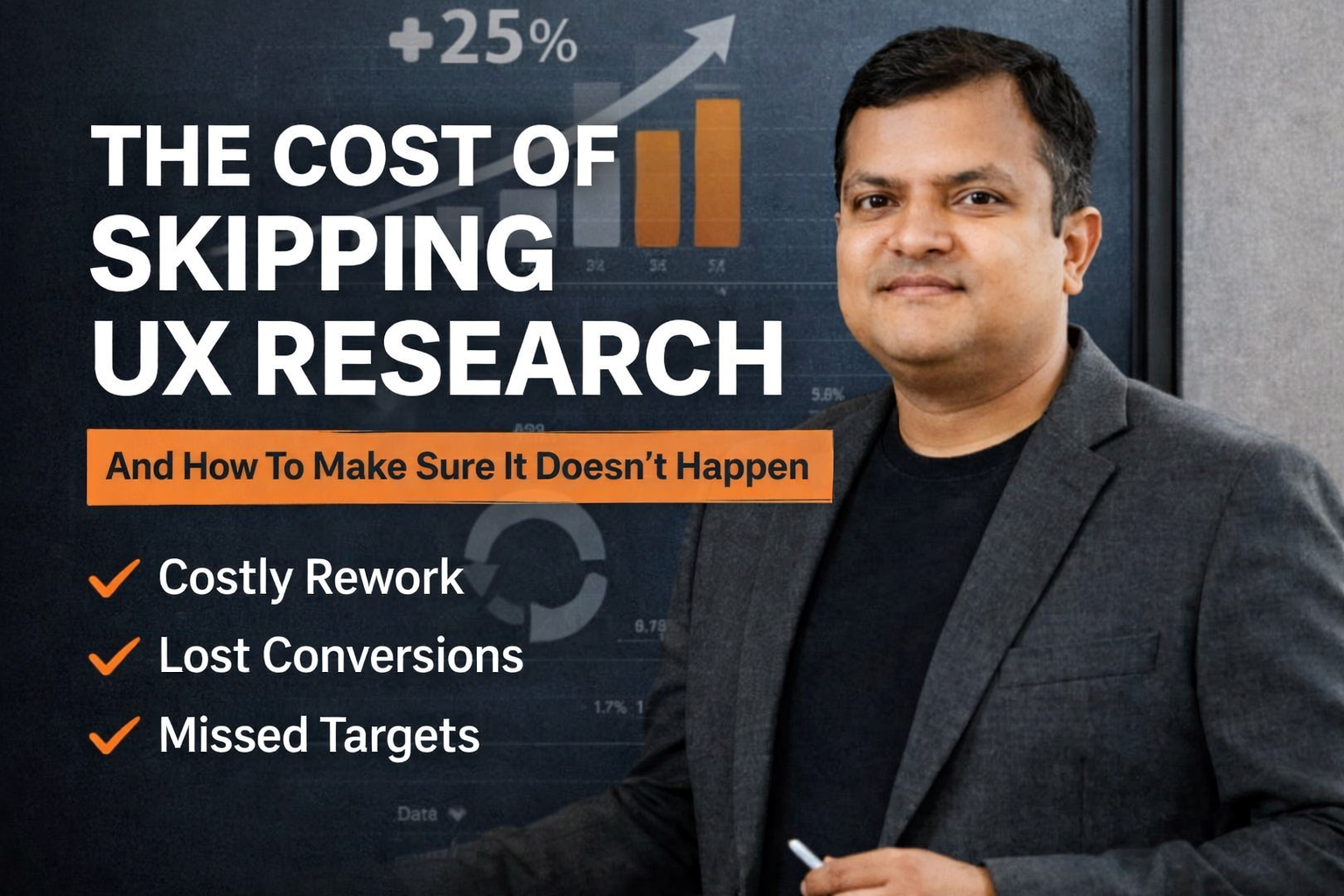
The Cost of Skipping UX Research
02
Feb
-
 Manoj Kumar
11 Min Read
Manoj Kumar
11 Min Read
In today’s hyper-competitive digital landscape, where user expectations evolve faster than ever, the cost of skipping UX research can cripple even the most promising ventures. As a C-suite founder or UX/product leader in a mid-size company, you’ve likely witnessed products flop not because of technical flaws, but due to a fundamental disconnect with users. This oversight isn’t just a minor hiccup—it’s a multimillion-dollar risk that drains resources, erodes market share, and stifles growth.
The cost of skipping UX research manifests in wasted development budgets, poor user adoption, and skyrocketing churn rates. According to Forrester Research, every dollar invested in UX yields a $100 return—a staggering 9,900% ROI—yet many organizations still treat research as an optional expense rather than a strategic imperative. With economic pressures mounting in 2026, ignoring user insights is no longer sustainable. In this post, you’ll learn the tangible impacts of bypassing UX research, real-world examples of failures, proven frameworks for integrating it effectively, and how it directly ties to business outcomes like higher conversions and retention.
The Financial Impact of Skipping UX Research
Skipping UX research doesn’t just lead to suboptimal designs—it hits your bottom line hard. Without user insights, products often require costly post-launch fixes, with errors discovered after release being up to 100 times more expensive to correct than during the design phase.
Consider the data: Businesses lose an estimated $1.4 trillion annually in sales due to poor UX, with 35% of potential revenue left on the table in e-commerce alone. For mid-size companies, this translates to millions in forgone opportunities. A study by Amazon Web Services highlights that 70% of customers abandon purchases due to bad user experiences, directly linking skipped research to revenue leakage.
Here’s a breakdown of key financial risks:
- Development Rework: Fixing UX issues post-launch can cost 10x more than addressing them early, per IBM research.
- Lost Productivity: In internal tools, poor UX wastes employee time, equivalent to unpaid labor—often 20-30% of project budgets.
- Customer Churn: 32% of users ditch a brand after one bad experience, amplifying acquisition costs.
To quantify: If your startup invests $500,000 in product development without research, you could face $5 million in downstream corrections and lost sales.
Real-World Examples of UX Failures Due to Skipped Research
History is littered with high-profile flops where assuming the user needs led to disaster. These cases underscore the consequences of ignoring UX research.
Take Quibi, the short-form video streaming service that raised $1.75 billion but shut down just six months after its 2020 launch. Founders skipped validating user demand for premium mobile-only content, assuming Hollywood backing would suffice. Result: Minimal subscribers, a $1.75 billion loss, and a textbook example of building in a vacuum.
Another: Snapchat’s 2018 redesign, which ignored user feedback and led to widespread backlash. The app’s stock dropped 6%, and over 1.2 million users signed a petition for reversal. A simple diary study or usability test could have prevented this, but assumptions about navigation changes cost them market share and trust.
Juicero’s $400 smart juicer failed spectacularly in 2017 after raising $120 million. Users discovered they could squeeze juice packets by hand, rendering the device obsolete. No market research uncovered this, leading to a shutdown after 18 months and massive investor losses.
Even giants falter: Coca-Cola’s “New Coke” in 1985 relied on blind taste tests but skipped broader user context, ignoring emotional attachments to the original. It cost $4 million in development and lost significant market share before reversion.
These examples—from startups like Quibi to enterprises like Coke—show how skipping UX research invites failure, often tagging prospects—investors or partners — in the fallout.
Why Skipping UX Research Is a Strategic Mistake
Skipping UX research might save a few weeks up front, but it puts months of development, revenue, and reputation at risk. Teams build products based on assumptions, not evidence, and users reject what doesn’t solve a real problem. This is the fundamental risk: building the wrong thing perfectly is worse than building the right thing slowly.
Hidden Business Costs
- Rework and remediation: Fixing UX issues post-launch can cost 10× more than discovering them early.
- Lost revenue: Poor UX directly causes drop-offs and abandoned conversions.
- Brand damage: Users equate a bad experience with untrustworthiness.
- Wasted development cycles: Teams may build features nobody uses.
- Opportunity cost: Competitors with better UX steal market share.
According to UXCam data, only ~55% of companies conduct UX testing, despite clear evidence that poor UX drives abandonment and damages trust.
The ROI of Investing in UX Research: Data-Driven Benefits
Flipping the script, investing in UX research delivers outsized returns tied to business outcomes. Forrester’s analysis shows a well-designed UX can boost conversion rates by 400%. Design-led companies outperform the S&P index by 228% over a decade.
Key benefits include:
- Higher Retention: 10% improvement in customer satisfaction from research-driven tweaks, worth millions in lifetime value.
- Competitive Edge: Early insights reveal unmet needs, as Airbnb did by researching user pain points to dominate the hospitality industry.
- Efficiency Gains: Reduce support costs by 30-50% through intuitive designs validated by testing.
A table illustrating ROI benchmarks:
| Investment Level | Expected ROI | Business Outcome Example |
| $1 in UX Research | $100 Return | Doubled sales conversions |
| 10% Budget Allocation | 2x Quality Metrics | Halved churn rates |
| Full Integration | 415% Overall ROI | $7.6M NPV over 3 years |
Tagging real companies: Google attributes its dominance to relentless UX research, while Slack’s user-focused iterations drove 1.5x faster revenue growth than peers.
Essential UX Frameworks to Avoid Skipping Research
To ensure UX research isn’t overlooked, adopt proven frameworks that align with business goals. Nielsen Norman Group’s usability principles—learnability, efficiency, memorability, errors, and satisfaction—provide a foundation.
Start with the Double Diamond model: Discover (research user needs), Define (prioritize insights), Develop (prototype), Deliver (test and iterate). This ties research to outcomes like faster time-to-market.
Practical steps:
- Conduct User Interviews: 5-10 sessions reveal pain points, costing under $5,000 but saving $50,000+ in rework.
- Usability Testing: Tools like UserTesting validate designs early, reducing errors by 50%.
- Analytics Review: Use Google Analytics to spot drop-offs and inform targeted improvements.
For decision-makers, frame research as risk mitigation: A $50,000 study yielding 300% ROI through revenue gains.
Common Mistakes When Implementing UX Research (and How to Fix Them)
Even with good intentions, pitfalls abound. One major error: Unclear goals, leading to irrelevant data. Fix: Define benchmarks like “reduce cart abandonment by 20%.”
Another: Wrong methodology—e.g., surveys for behavioral insights instead of observational studies. Solution: Match methods to questions (qualitative for “why,” quantitative for “what”).
- Bias in Participant Selection: Avoid by recruiting diverse users via tools like User Interviews.
- Ignoring Iterative Testing: Test at multiple stages to catch issues early.
- Overlooking Accessibility: Ensure research includes all users to avoid legal and UX risks.
By addressing these, mid-size firms can achieve 83% higher conversions with just 10% more UX investment.
Pain-Point Tutorials: Step-by-Step Guide for Decision-Makers
As a founder or product head, tackling UX research under tight timelines can feel daunting. Here’s a weekly tutorial to integrate it without disruption.
- Week 1: Audit Current Processes: Review recent launches for UX gaps using FAQ reviews and analytics.
- Week 2: Engage Stakeholders: Comment on decision-maker content (e.g., LinkedIn posts by peers at companies like Slack) to build buy-in.
- Week 3: Run Quick Wins: Conduct 5 user interviews focusing on top pain points.
- Week 4: Analyze and Iterate: Use insights to prototype fixes and measure against KPIs, such as retention.
This approach turns research into a conversion engine, with case studies showing 7.2% uplift in rates.
Why UXGen Studio Is the Best Partner for Solving This

At UXGen Studio, we’ve helped companies avoid costly product missteps by institutionalizing research and translating insights into measurable business impact.
Case Study: Fintech SaaS Client
- Context: A fintech SaaS product saw severe onboarding drop-offs (45% abandonment before activation).
- Approach:
- Conducted mixed-method UX research (surveys + usability testing)
- Identified key friction points in the onboarding flow
- A/B tested optimized layouts and messaging
- Outcome:
- Onboarding success improved by 38%
- Feature adoption increased by 22%
- Business reported a $450K ARR uplift within 6 months
- Client Insight:
“UXGen’s research reframed our assumptions — we weren’t building too many features, we were building the wrong ones.”
We use a systematic framework:
- Discovery — Align business goals to user needs
- Mixed-method execution — Qual + Quant
- Actionable reporting — Business KPIs, not design jargon
- Decision maps — AI-enabled prioritization for product teams
👉 FREE! Download UX Research ROI Template + Executive Brief
Convert your next research initiative into a board-ready strategy:
What’s inside:
- ROI calculator (investment vs. expected revenue)
- Research planning checklist
- Executive email templates to win stakeholder approval
Conclusion
Skipping UX research isn’t a shortcut—it’s a costly detour that jeopardizes product success, revenue, and user loyalty. By understanding the financial impacts, learning from failures like Quibi and Snapchat, and leveraging integration frameworks, you can drive measurable business outcomes. Prioritize research to boost ROI, retention, and competitiveness.
Ready to safeguard your next launch? Download our free UX Research Checklist today—a gated lead magnet packed with templates and audits to get started. Download the UX Research Checklist. Take this step now to transform assumptions into actionable insights.
FAQ Section

What is the cost of skipping UX research in product development?
Skipping UX research often results in products misaligned with user needs, leading to rework costs up to 100x higher post-launch. Data shows $1.4 trillion in global lost sales due to poor UX, with businesses facing 35% e-commerce revenue leakage from abandonment.
Why is UX research important for business outcomes?
UX research validates assumptions, improving usability and satisfaction. It yields a 9,900% ROI, boosts conversions by 400%, and enhances retention by 10%, directly tying to faster revenue growth and lower support costs.
How does poor UX affect customer retention?
Bad experiences drive 32% of users to abandon a brand after a single incident, increasing churn and acquisition costs. Research-driven designs reduce this by addressing pain points early, fostering loyalty and repeat business.
What are common consequences of ignoring UX research?
Consequences include failed products (e.g., Quibi’s $1.75B loss), higher development expenses, and competitive disadvantages. Without insights, designs rely on biases, leading to low adoption and negative reviews.
How much does UX research typically cost, and is it worth it?
Costs range from $5,000 for basic interviews to $50,000 for comprehensive studies, but returns are immense—$100 per $1 invested. For mid-size firms, it’s a low-risk investment yielding 300%+ ROI through efficiency gains.
What methods should I use for effective UX research?
Combine qualitative (interviews, usability testing) and quantitative (surveys, analytics) methods. Start with discovery via field studies, then test prototypes iteratively to ensure alignment with user behaviors.
Can skipping UX research lead to legal issues?
Yes, poor UX can overlook accessibility, risking ADA lawsuits. Inclusive research ensures compliance, avoids fines, and broadens your market reach.
How to convince stakeholders to invest in UX research?
Frame it as risk mitigation with data: Show case studies like Snapchat’s redesign backlash or Forrester’s ROI stats. Highlight quick wins, like a $50K study preventing $200K in losses.
What role does UX research play in agile development?
In agile, research informs sprints through continuous testing, reducing pivots and accelerating launches. It ties user feedback to iterations, improving product-market fit.
How often should companies conduct UX research?
Conduct it at key stages: Discovery, pre-launch, and post-release quarterly reviews. In fast-moving markets, weekly engagement, such as stakeholder comments, keeps insights fresh.
𝗡𝗲𝗲𝗱 𝗨𝗫 𝗰𝗼𝗻𝘀𝘂𝗹𝘁𝗮𝗻𝗰𝘆 𝗲𝘅𝗽𝗲𝗿𝗶𝗲𝗻𝗰𝗲 𝗱𝗲𝘀𝗶𝗴𝗻 𝗲𝘅𝗽𝗲𝗿𝘁𝗶𝘀𝗲?
Drive Better Retention & Smarter UX Decisions with UXGen Studio
Every great UX Audit should lead to action — but turning insights into impactful product improvements requires strategy, discipline, and execution expertise.
At UXGen Studio, we help SaaS and digital product teams:
✔ Uncover deep user insights and hidden friction
✔ Translate research into prioritised UX improvements
✔ Reduce churn and accelerate retention
✔ Improve activation, engagement, and conversion
✔ Align UX strategy with business outcomes
Whether you’re just starting your UX Audit or ready to evolve your UX practice into a growth engine, we can help you turn research into measurable results.
How We Partner With You
Strategic UX Consulting
• UX research planning & execution
• Usability testing & user interviews
• Churn analysis & retention UX strategies
UX Audit to Action
• Prioritised UX recommendations
• Roadmaps aligned to product goals
• Design system & UI improvements
Implementation Support
• UX design + prototyping
• Collaboration with product & engineering
• Ongoing measurement & optimisation
Let’s Connect
If you found this UX Audit Process valuable, imagine what a tailored engagement could do for your product.
📍 Website: https://www.uxgenstudio.com
📍 Based in Gurugram, India — we work with learners globally.
📧 Email: business@uxgenstudio.com
📞 WhatsApp / Mobile: +91 9718540053
📞 Schedule a Consultation: https://www.uxgenstudio.com/contact
📌 LinkedIn: https://www.linkedin.com/company/uxgen-design-studio/
📌 Youtube: https://www.youtube.com/@UxgenStudio
📌 Instagram: https://www.instagram.com/uxgenstudio/
Free UX Audit Support Offer
As a thank-you for reading this document, we offer a complimentary 30-minute UX strategy consultation for teams serious about reducing churn and boosting retention.
➡️ Book your session now:
Why UXGen Studio?
We don’t just design interfaces — we solve product challenges with clarity, data, and human insight. Our work helps product leaders make confident decisions backed by research, not guesswork.
Here’s what you gain when you work with us:
✔ Business-aligned recommendations, not generic UX tips
✔ Actionable priorities that move KPIs
✔ Faster impact with structured UX frameworks
✔ Hands-on collaboration with product teams
Closing Thought
UX is too strategic to be an afterthought.
Done right, it becomes a growth lever — turning retention into revenue and insights into outcomes.
Previous Post

Designing UX for Dopamine: How to Drive Engagement Without Destroying Trust
Next Post
From Guidance to Manipulation: the New Reality of UX

About the Author

Latest Posts



Subscribe for fresh
tips & top articles
UXGen Studio uses the data submitted through this form to send you relevant marketing insights, blog updates, and learning resources. To learn more, read our Privacy Policy.
